Scholarships, Grants, Loans
Paying for college does not have to be overwhelming. Anoka-Ramsey offers a wide range of scholarships, grants and student loan options to help make your education affordable. Start by completing a financial aid (FAFSA) application.
Invest in your future...
- Scholarships based on academic achievement, leadership, and community involvement
- Federal and state grants that don’t need to be repaid
- Low-interest student loans with flexible repayment options
Financial Aid Workshops
Scholarships
Current Student Scholarship Application
STUDENTS SIGN IN: Use your StarID username and StarID password.
Prospective Student Scholarship Application
| Scholarship Application Available (Portal Open) | Scholarship Application Deadline | Semester Scholarship is Awarded |
|---|---|---|
| October 1 | October 31 | Spring Semester |
| April 1 | April 30 | Fall Semester |
Accommodations: Scholarship applications must be filled out online. If you require an accommodation for a disability, visit Office for Students with Disabilities for more information.
Writing Support/Tutoring: Tutors are available to help applicants improve essays. Visit Tutoring Services for more information.
PSEO Students: PSEO students are ineligible to apply for and receive Foundation scholarships unless they are applying for a scholarship that would be awarded after they graduate from high school.
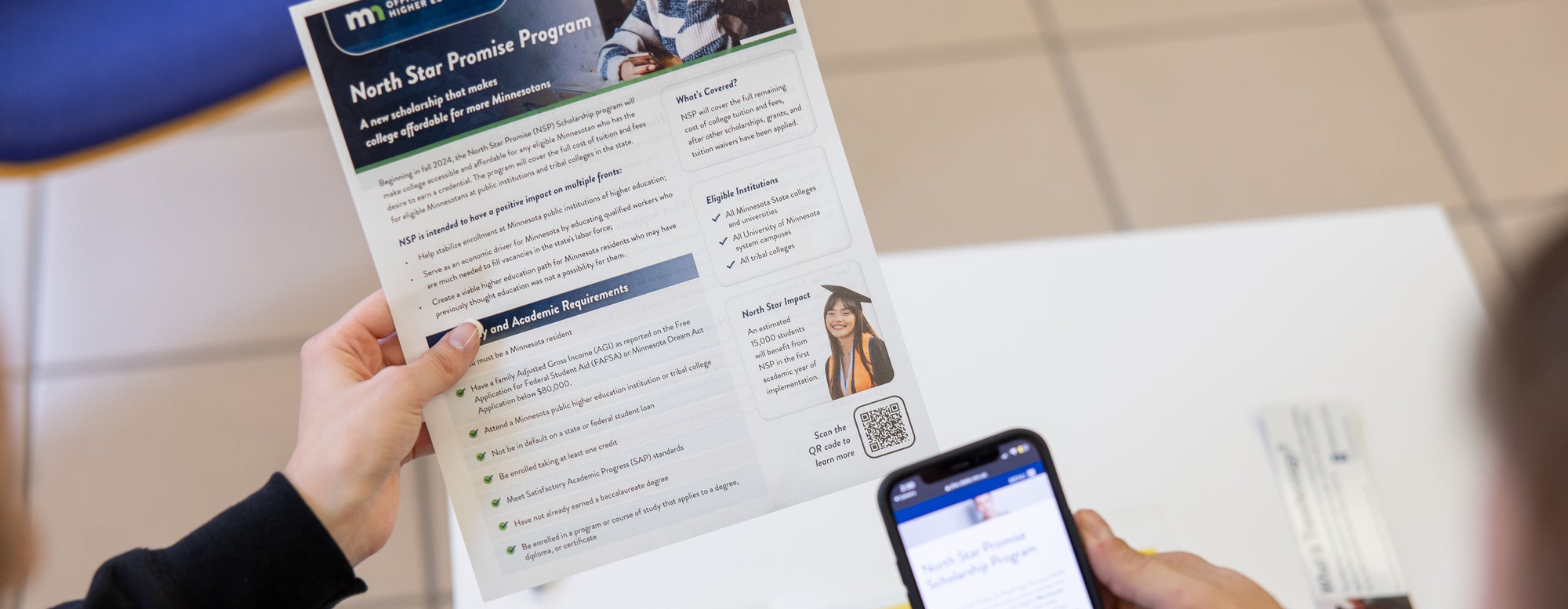
The North Star Promise (NSP) Scholarship program is a tuition and fee-free pathway to higher education for eligible Minnesota Residents at eligible institutions. The NSP scholarship is considered a “last-dollar” program by covering the balance of tuition and fees remaining after other scholarships, grants, stipends, and tuition waivers have been applied.
June 1, 2026 is the deadline for the 2026-27 FAFSA to be considered for the North Star Promise Scholarship for the 2026-2027 school year (Fall 2026, Spring 2027, Summer 2027).
Eligible Students Must:
- Be a Minnesota resident
- Have a family Adjusted Gross Income (AGI) below $80,000 (FAFSA or Minnesota Alternative State Aid Application)
- Attend a Minnesota public higher education institution or Tribal College
- Not be in default on a state or federal student loan
- Meet Satisfactory Academic Progress (SAP) standards
- Have not already earned a baccalaureate degree
- Be enrolled in a program or course of study that applies to a degree, diploma, or certificate
North Star Promise Application: The process begins when you complete your application for Federal Financial Aid or the Minnesota Alternative State Financial Aid Application.
Apply for Minnesota Alternative State Financial Aid Application
Apply for Workforce Development Scholarship (PDF)
Made possible through Minnesota State legislation, a limited number of $2,500 scholarships ($1,250 per Fall and Spring semesters).
Available to Students Seeking a Certificate, Diploma or Degree in:
- Alcohol & Drug Counseling Studies
- Applied Engineering Technology-Biomedical
- Biomedical Technology
- Business Computer Applications
- Business Crisis & Emergency Management
- Business: Workplace & Technology Emphasis
- Clinical Research Professional
- Computer Networking
- Computer Network Security
- Computer Programming
- Computer Science Transfer Pathway
- Cybersecurity
- Elementary Education Transfer Pathway
- Engineering
- Environmental Science
- Exercise Science Transfer Pathway
- Fitness Specialist Certificate
- Health Sciences Broad Field
- Integrative Health & Healing
- IT Support Specialist
- Network Support & Administration
- Nursing
- Pharmacy Technician
- Physical Therapy Assistant
- Public & Community Health
- Special Education Transfer Pathway
- System Administration
- Therapeutic Massage
Eligibility:
- Students must be enrolled in a minimum of 9 credits per term.
- Students must maintain a cumulative 2.0 GPA (for the next semester to be awarded).
- Retaken courses will not be eligible for this scholarship. Only first-time attempted credits will count toward the 9-credit minimum.
- Students who withdraw from their courses after disbursement of the scholarship may be liable for repayment of the scholarship.
- Students may receive the scholarship up to a maximum of 4 semesters.
- A new application must be submitted each academic year to be considered for eligibility.
- Must be a Minnesota Resident.
- Awards made on a first-come, first-serve basis to eligible students as funding allows.
Big Future by The College Board
Ethel Curry American Indian Leadership Scholarship
Get Ready Student Success Scholarship
Horatio Alger Career & Technical Scholarship
Minnesota Association of Counselors of Color
Go-to Guide for College Financial Aid
Wallin Education Partners(Note: Wallin Education Partners has specific eligibility requirements around financial need and partner high school. Please review their eligibility criteria thoroughly.)
Grants
Anoka-Ramsey students may be eligible for grants listed here. Grants are a form of financial aid that does not have to be repaid. They can be provided by the federal government, the state of Minnesota, private organizations or non profit organizations. To be considered for a grant, start the process by applying for Financial Aid (FAFSA).
Almost all federal grants and state grants are awarded to students with financial need. Most grants also require students to main satisfactory academic progress.
- Other applications may be required
- Grants may reduce your eligibility for other financial aid
- Students who plan to attend summer session may also be eligible for grants
- Most grants require students to maintain satisfactory academic progress
The Pell Grant Program is a federal grant. The maximum Federal Pell Grant award is $7,395 for the 2025-2026 award year (July 1, 2025, to June 30, 2026)
Changes to Pell Grant Funding
- Students whose Student Aid Index (SAI) equals or exceeds twice the maximum Pell Grant award will no longer be eligible for a Pell Grant.
- Students whose non-federal grants and scholarships fully cover their cost of attendance will not receive a Pell Grant , even if they would otherwise qualify based on financial need. Non-federal aid includes institutional scholarships, state grants, and private scholarships.
What this means for you:
- If you receive grants or scholarships from non-federal sources (private organizations, Minnesota grants, scholarships from Anoka-Ramsey, that are equal to or greater than what it costs you attend the college, you will no longer receive a Pell Grant.
NOTE: To be eligible for a Pell Grant, students must be registered for the courses they intend to complete by the fifth (5th) day of each term.
Changes to your schedule after the add/drop period for Pell Grant: Your class schedule must be firm and you should not make any changes after the 5th day of the semester or you risk aid reductions. It is expected that you will attend your registered courses. If you decide to add a late start course after the 5th day of the semester your Pell Grant cannot be adjusted unless you complete a Pell Grant appeal. If you drop a class and add another class that is the same number of credits after the 5th day of the semester, your aid will be negatively affected, as the add will not be recognized.
The Federal Supplemental Educational Opportunity grant (FSEOG) is awarded to undergraduate students who have exceptional financial need and have not yet earned a bachelor’s or graduate degree. Student need and application timing determine the availability of funds.
The state GI Bill® provides financial assistance to eligible Minnesota veterans and service members, as well as eligible spouses and children of deceased or severely disabled eligible Minnesota veterans.
Full-time undergraduate or graduate students may be eligible to receive up to $5,000 per academic year. For more information about the MN GI Bill and eligibility requirements, please visit MN GI Bill / Minnesota Department of Veteran Affairs - State of Minnesota.
State grants help students from low- and moderate-income families pay for educational expenses at eligible Minnesota colleges or universities. Students must be at least 17, residents of Minnesota and graduates of a secondary school/high school or its equivalent.
- Students must be enrolled for at least three credits at Anoka-Ramsey or another eligible school
- Applicants are required to contribute at least 50 percent of their price of attendance out of savings, earnings, loans or other assistance from school or private sources
- FAFSA application must be received by the federal processing center within 30 calendar days of the start of the semester
The Postsecondary Child Care Grant Program helps eligible students offset the cost of existing out-of-pocket child care expenses for their young children while the student attends classes, works, or studies.
The Anoka-Ramsey Crisis Grant Program was designed to help students out of a financial crisis by providing short-term assistance. To learn more, contact the Counseling Office at 763-433-1100.
Loans
To qualify for federal loans, students must be enrolled at least half-time (six credits or more) when their aid is disbursed.
The Department of Education limits the amount of federal loans students may borrow each year and over their lifetimes. Three types of federal loans are available to students or their parents. Each has different interest rates and repayment terms.
- Direct Loans (Subsidized or Unsubsidized)
- Direct PLUS Loans (Parent Loans for Undergraduate Students)
- Private Loans
Changes to Federal Direct Subsidized and Unsubsidized Student Loans
- Students enrolled less than full-time (less than 12 credits) will no longer qualify for the full annual federal loan amount. Loan eligibility will be reduced proportionally based on enrollment level.
- If a student drops credits after the term begins and falls below full-time enrollment, schools may be required to reduce previously awarded loan amounts. This could result in a balance owed to the institution.
- All federal loans now count toward a student’s lifetime federal loan cap of $31,000 for Dependent undergraduate students and $57,500 for Independent undergraduate students. Undergraduate includes both community college and university enrollment. A total cap for federal borrowing has been set at $257,000 (excluding Parent PLUS Loans). This includes borrowing for graduate and professional school.
What this means for you:
- If you enroll part-time, your yearly loan eligibility may be reduced.
- If you drop or withdraw from a course and your enrollment drops below full-time, your loan eligibility may be reduced. This could mean you owe Anoka-Ramsey money.
Direct Loans: Offered by the federal government. Direct Loans can be subsidized or unsubsidized.
Subsidized Loans: The Department of Education pays the interest
- While you are enrolled at least half time
- First six months after you leave school (grace period)
- During a period of deferment
Unsubsidized Loans: You are responsible for paying interest on this loan during all periods. Students may choose to pay interest while attending school so that it doesn’t increase the principal balance./p>
Interest Rate: The interest rate for undergraduate students whose subsidized or unsubsidized Direct Loan is disbursed on or after July 1, 2025 through July 1, 2026 is fixed at 6.39%.
Entrance Counseling and Master Promissory Note: Loan Entrance Counseling and the Master Promissory Note, which are both required prior to disbursement of your first federal loan, can be completed atFederal Student Aid.
Six-Credit Minimum: Each of these loan programs have a six-month grace period if a student drops below six credits (half-time) -- an important consideration when withdrawing from courses. If you withdraw and are enrolled in less than six credits, your grace period will begin.
Circumstances that may change your grace period include the following:
- Active duty military—If you are called to active military duty for more than 30 days before the end of your grace period, you will receive the full six-month grace period when you return from active duty.
- Returning to school before the end of your loan’s grace period—If you reenroll in school at least half-time before the end of your grace period, you will receive the full six-month grace period when you stop attending school or drop below half-time enrollment (other conditions apply).
- Loan consolidation — If you consolidate your loans during your grace period, you will
give up the remainder of your grace period and begin repayment after your Direct Consolidation
Loan is disbursed (paid out). Your first bill will be due approximately two months
after the Direct Consolidation Loan is disbursed.
PSEO Students: PSEO students are ineligible to apply for and receive Foundation scholarships unless they are applying for a scholarship that would be awarded after they graduate from high school.
Changes to Parent PLUS Loans
- Beginning July 1, 2026, Parent PLUS Loans will be capped at $20,000 per year per dependent student. A new lifetime (aggregate) Parent PLUS borrowing limit of $65,000 per student will apply.
- Parent PLUS Loans will no longer automatically cover the full cost of attendance, meaning families may need to use other funding sources such as savings, scholarships, payment plans, or private loans.
- Some families may qualify for legacy (grandfathered) provisions, allowing borrowing under prior rules if the student and/or parent received qualifying federal loans before July 1, 2026 and remain continuously enrolled in the same program.
- If a student withdraws from a semester or does not attend for a semester, they no longer qualify for legacy provisions.
What this means for you:
- Parent PLUS Loans may no longer cover the full cost of attendance. That means your family may need to find additional sources of funding to cover your cost of attendance.
- Your family may qualify for exemptions to new borrowing rules. If you are eligible, you will need continue attending Anoka-Ramsey uninterrupted to remain eligible for legacy status.
Parent Loans for Undergraduate Students (PLUS) are for parents whose children are enrolled at an approved educational institution at least half-time (six credits).
- The maximum loan amount is based on the student’s other financial aid and the cost of attendance.
- Interest accrues and payments are required from the time the loan is made until it is paid off.
- You must not have an adverse credit history
The interest rate for parents whose PLUS Loan is disbursed on or after July 1, 2025 and before July 1, 2026 is fixed at 8.94%.
Before applying for a private loan, students should apply for Financial Aid by completing the Free Application for Federal Student Aid (FAFSA) to determine if they are eligible for federal financial aid.
Eligibility for private loans is based on the eligibility of a borrower and/or co-signer. Private loans may have higher interest rates than federal loans and should only be considered a borrowing option after all federal loan eligibility has been exhausted.
Selecting a private lender is the responsibility of the student.
Anoka-Ramsey provides this private loan search tool for comparing loan options. The college does not endorse any one lender; you may choose any private lender you like. This FastChoice search tool includes lenders that have most commonly provided private loans to Anoka-Ramsey students during the past three years.
Under the Truth in Lending Act rules, private education loans are subject to self-certification,
three consumer disclosures at specific times in the application process, and at least
a three-day delay in disbursement. Due to the number of steps involved in the private
loan application process, applicants should allow a minimum of three weeks for processing.
This information is intended to be accurate, but the publisher does not assume liability
for errors or omissions.
- Students have the ability to refuse all or accept only a portion of the loan funds available to them. If you wish to cancel all or a portion of your loan funds, you must provide a written request to the financial aid office. For questions on what is required to cancel your loan, contact the financial aid office by phone 763-433-1500 or email financialaid@anokaramsey.edu
- Students have the right to cancel all or a portion of their federal, state, or private loan funds any time prior to disbursement. Parents have the right to cancel all or a portion of their federal PLUS loan any time prior to disbursement.
- You have the right to cancel all or a portion of your Federal Direct or PLUS loan disbursement any time within 14 days from the date of your Title IV disbursement notification.
- Students may return any funds they do not wish to accept by returning that portion to the loan servicer directly or you may request that Anoka-Ramsey cancel some or all of the loan and return the funds on your behalf.
- All loans must be repaid. Make sure you understand when repayment of principal and/or interest is expected. Payments to some loans may begin earlier than others.
- Make sure you understand all of your rights and responsibilities under the loan program(s) you choose and contact the lender with any questions you may have.
- If you are using a co-signer to acquire a loan make sure they understand their obligations.
Send Document to Financial Aid
All Financial Aid Forms
Crisis Grant Recipient Story

Important Dates & Deadlines
March 30
Registration opens
Aug. 3
Tuition due
Aug. 24
Fall semester begins
Aug. 31
Drop for non-payment
Dec. 18
Fall semester ends
Oct. 19
Registration opens
Dec. 17
Tuition due
Jan. 11
Spring semester begins
Jan. 19
Drop for non-payment
May 14
Spring semester ends
Nov. 2
Registration opens
May 10
Tuition due
June 1
Summer semester begins
June 7
Drop for non-payment
Aug. 6
Summer semester ends